
Commercial Solar for Scottish Retail Businesses Reduce Costs, Improve Sustainability
From single stores to multi-site portfolios, commercial solar cuts your energy operating costs, improves your EPC rating and demonstrates environmental commitment to customers and investors.
Sector Overview
Commercial solar PV for the Retail sector
Sector overview
Retail businesses in Scotland face a persistent energy cost challenge. Lighting, HVAC, refrigeration, till systems and security all run during trading hours, creating a predictable daytime energy demand profile that aligns well with solar generation. For retailers with suitable rooftop space – whether a single large-format store or a portfolio of units across Scotland and the UK – commercial solar PV offers a proven route to lower operating costs and stronger sustainability credentials.
Caledonia Solar works with retail businesses across Scotland, from single-site owner-occupiers to property portfolio managers. We understand the constraints of retail environments – the need for minimal disruption to trading operations, the complexity of multi-site funding and the increasing importance of EPC ratings in commercial leasing. We design, fund and deliver solar projects that fit the commercial reality of retail property.
Commercial solar is one of the most cost-effective interventions available to multi-site retailers looking to reduce operating costs at scale - typically improving EPC ratings by 1–2 bands, reducing service charge energy costs and delivering a financial return that does not require any change to customer-facing operations.
The Energy Challenge
The energy challenges facing retail businesses
Retail energy costs are largely fixed and difficult to reduce through operational changes. Lighting must run during trading hours, HVAC is driven by customer comfort requirements, and refrigeration in food retail is non-negotiable. As grid electricity prices have risen, energy has moved from a manageable overhead to a material cost line on the P&L - particularly for retailers with multiple sites.
Commercial properties are increasingly valued and leased against EPC performance. A poor EPC rating affects rental value, lease terms and the ability to attract quality tenants. Solar PV improves a building’s EPC rating by reducing the carbon intensity of electricity consumed, supporting compliance with Minimum Energy Efficiency Standards and protecting the long-term value of retail property assets.
Retail customers, particularly in the grocery, fashion and consumer goods sectors, are increasingly making purchasing decisions based on a retailer’s environmental credentials. Institutional investors and lenders are also incorporating ESG performance into property valuations and lending decisions. Visible solar investment on a retail property is a tangible sustainability commitment that can be communicated directly to customers and stakeholders.
Why Solar Works in This Sector
Why commercial solar PV works for retail businesses
- Trading hours alignment: Most retail energy consumption occurs during trading hours – typically 08:00–20:00 – which overlaps with the solar generation window, enabling high self-consumption rates.
- EPC improvement: Solar generation reduces the regulated energy consumption figure used in EPC calculations, directly improving the rating and supporting compliance with MEES obligations.
- Multi-site portfolio efficiency: For retailers with multiple properties, a portfolio solar programme can deliver economies of scale in design, procurement and installation, with a single funding structure across all sites.
- Customer-facing visibility: Solar panels on a retail property are visible to customers, employees and the public – providing tangible evidence of sustainability investment that supports marketing and communications.
- Long-term cost certainty: Solar generation provides a locked-in source of low-cost electricity insulated from grid price movements, supporting long-term operating cost planning for retail businesses.
Indicative Project Parameters
What size commercial solar system does a retail building typically need?
Retail properties with solar installations consistently achieve better EPC ratings than comparable unimproved buildings - with measurable impact on lettability, rental value and MEES compliance risk in the Scottish and UK commercial property market.
For multi-site retail operators, a portfolio solar programme structured under a single framework agreement typically reduces per-site installation cost by 15–25% compared to individual site-by-site procurement - improving the financial case across the portfolio.
How commercial solar reshapes your energy P&L
A well sized commercial solar installation typically displaces 60 to 80 percent of daytime grid consumption, with the strongest yield months running from April through September. Over a 25 year system life, businesses on standard commercial tariffs see total energy spend reduce by hundreds of thousands of pounds depending on system scale and consumption profile.
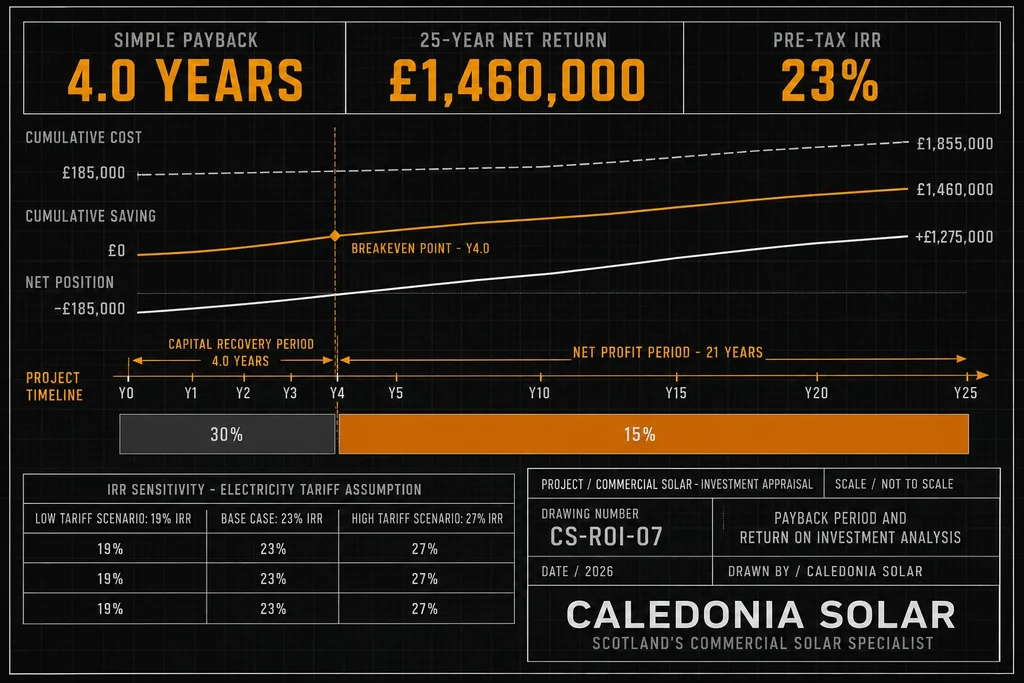
The illustration above brings together the funding structure, grid connection profile, and operational performance characteristics most relevant to retail. Each parameter feeds directly into the financial model we build for every project enquiry.
Case Studies
Projects in Retail
Case studies for this sector will be published shortly as projects complete.
Start Your Project →FAQ
Common questions about solar for retail
Find out what solar is worth for your retail business
Enter the details for your retail property or portfolio. Our calculator returns indicative annual savings, EPC impact and payback period based on your trading hours, roof area and energy consumption.