
Commercial Solar for Scottish Manufacturers Cut the Energy Cost in Every Unit You Produce
Manufacturing energy demand peaks during production hours - exactly when solar generates most effectively. Caledonia Solar designs systems that match your production profile and structure funding around your business.
Sector Overview
Commercial solar PV for the Manufacturing sector
Sector overview
Manufacturing businesses in Scotland and the wider UK face a structural energy cost challenge. Machinery, compressed air, HVAC, process heat and lighting run during production hours – creating a predictable, high-intensity energy demand profile that tracks directly with business activity. As grid electricity prices have risen sharply since 2021, energy has become an increasingly significant cost embedded in every unit of output.
Commercial solar PV addresses this challenge directly. A system sized to match your production schedule generates free electricity during the hours your facility consumes most – reducing the grid electricity cost embedded in production, improving cost competitiveness and supporting the ESG reporting requirements that manufacturers increasingly face from customers, investors and supply chain partners.
Single-shift manufacturing in Scotland achieves among the highest solar self-consumption rates of any commercial sector - typically 75–90% - because production hours and peak solar generation hours align directly, meaning most of the electricity generated is used immediately in production rather than exported at a lower rate.
The Energy Challenge
The energy challenges facing manufacturing businesses
For manufacturers, electricity is a direct production input. When grid prices rise, the cost of every unit produced rises with them - squeezing margins and undermining competitiveness. Unlike labour or materials costs, energy costs cannot be negotiated or offset through productivity improvements. Solar generation removes a proportion of that cost permanently.
Manufacturers are increasingly required to report and reduce scope 2 carbon emissions - the emissions associated with purchased electricity. Major customers, particularly in automotive, food and drink, and consumer goods, are embedding supply chain carbon commitments into procurement decisions. Solar generation directly reduces the carbon intensity of electricity consumed in production, improving your position in customer sustainability assessments.
Manufacturing businesses typically run on multi-year contracts with customers but purchase electricity on shorter-term tariffs. Grid price increases between contract renewals compress margins without the ability to pass costs forward. Solar generation provides a locked-in source of low-cost electricity that is insulated from grid price movements for the operational life of the system.
Why Solar Works in This Sector
Why commercial solar PV works for manufacturing businesses
- Load profile alignment: Single-shift manufacturing operations typically run 06:00–18:00 – almost exactly matching the solar generation window in Scotland. Self-consumption rates of 75–90% are achievable for well-specified systems aligned to production schedules.
- Large industrial roofs: Manufacturing facilities typically occupy large single-storey buildings with substantial flat or low-pitch roof areas, supporting system sizes of 100kW–500kW+ without roof space constraints.
- Long building tenure: Manufacturing businesses typically occupy premises for 10–25+ years – sufficient horizon to realise the full financial return of a solar system over its operational life.
- Capital allowance efficiency: For CapEx purchase, manufacturing businesses can typically use Full Expensing to recover the full installation cost in year one against corporation tax – significantly improving the post-tax financial return.
- Visible sustainability commitment: Solar panels on a manufacturing facility are a visible signal of sustainability investment to customers, employees and the local community – supporting ESG reporting and brand positioning.
Indicative Project Parameters
What size commercial solar system does a manufacturing building typically need?
UK manufacturers that have installed commercial solar report scope 2 emissions reductions of 25–60% depending on system size and production profile, directly improving their position in customer supply chain sustainability assessments.
Manufacturing businesses in Scotland benefit from Full Expensing capital allowances on solar investment - recovering the full installation cost against corporation tax in year one and materially improving the post-tax payback period compared to the pre-tax calculation.
How commercial solar reshapes your energy P&L
A well sized commercial solar installation typically displaces 60 to 80 percent of daytime grid consumption, with the strongest yield months running from April through September. Over a 25 year system life, businesses on standard commercial tariffs see total energy spend reduce by hundreds of thousands of pounds depending on system scale and consumption profile.
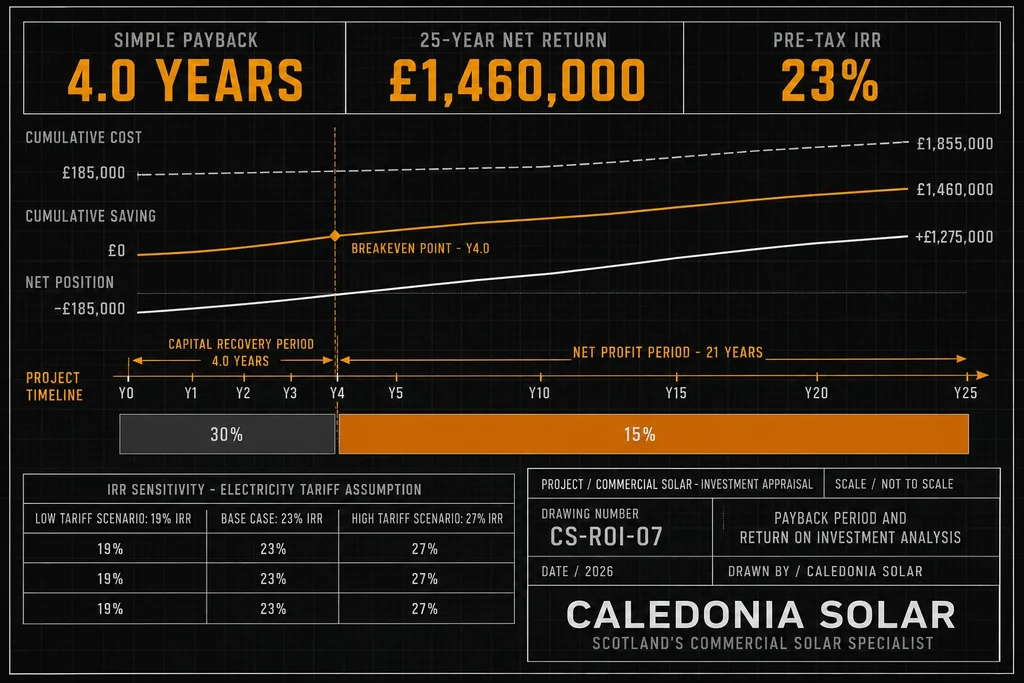
The illustration above brings together the funding structure, grid connection profile, and operational performance characteristics most relevant to manufacturing. Each parameter feeds directly into the financial model we build for every project enquiry.
Case Studies
Projects in Manufacturing
Case studies for this sector will be published shortly as projects complete.
Start Your Project →FAQ
Common questions about solar for manufacturing
Find out what solar is worth for your manufacturing business
Our calculator uses your roof size, monthly energy consumption and production schedule to model the financial case for solar at your facility. Indicative results in under 60 seconds.