
Commercial Solar for Cold Storage and Refrigerated Warehousing in Scotland
Cold stores run around the clock. So does your energy bill. Commercial solar cuts the cost of refrigeration energy permanently - with no operational disruption and no capital outlay required.
Sector Overview
Commercial solar PV for the Cold Storage sector
Sector overview
Cold storage and refrigerated warehouse operations are among the most energy-intensive commercial activities in Scotland and the wider UK. Refrigeration plant, blast freezers, controlled atmosphere storage and ancillary systems run continuously, generating electricity costs that are significant, predictable and largely unavoidable. For cold store operators, energy is not a discretionary cost – it is a structural operating expense embedded in every pallet moved.
Commercial solar PV does not eliminate that cost, but it permanently reduces the proportion of it paid at grid tariff. A well-specified rooftop system generates electricity during daylight hours, directly offsetting refrigeration load at the point of consumption. Combined with a battery storage system, the proportion of free or low-cost generation can extend into evening and overnight operations. Caledonia Solar designs cold storage solar projects around the specific load profile of the facility, not a standard specification.
Cold storage operations have the highest energy intensity of any commercial sector in Scotland, making them the most financially compelling case for commercial solar investment - a medium-sized cold store spending £200,000–£400,000 per year on electricity can typically offset 20–40% of that cost permanently with a rooftop solar system.
The Energy Challenge
The energy challenges facing cold storage businesses
Refrigeration plant cannot be switched off during high-tariff periods without compromising product integrity. Unlike manufacturing or logistics operations, cold stores have almost no demand-side flexibility - the energy runs continuously regardless of grid price. This makes cold stores uniquely exposed to electricity price increases and uniquely well-suited to any technology that reduces the unit cost of electricity.
For most cold store operators, electricity accounts for 30–50% of total operating costs. At current Scottish commercial electricity tariffs, a medium-sized cold store of 5,000m² may spend £200,000–£400,000 per year on electricity. Solar does not solve the whole problem, but for a building with suitable roof area it can address 20–40% of that cost permanently.
Cold chain operations face increasing scrutiny of their carbon footprint from food retailers, logistics customers and lenders. Reducing the carbon intensity of electricity consumed directly improves scope 2 reporting and supports compliance with supply chain sustainability commitments. Solar generation carries a zero-carbon attribution at the point of use.
Why Solar Works in This Sector
Why commercial solar PV works for cold storage businesses
- Roof area: Cold stores and refrigerated warehouses typically have large, flat, unobstructed roofs – the ideal configuration for maximum solar capacity.
- Energy intensity: High electricity consumption means a larger system can be specified and the financial return is proportionally greater than for lower-intensity commercial uses.
- Daytime load offset: Even for 24/7 operations, daytime electricity consumption is typically higher due to door openings, staff activity and ancillary systems. Solar generation directly offsets this peak.
- Battery storage synergy: Cold storage operations benefit significantly from pairing solar with battery storage – excess daytime generation is stored and discharged during evening and overnight refrigeration load. Caledonia Solar designs combined solar and storage systems for cold store clients.
- Grid resilience: Cold stores cannot tolerate power outages. A solar and storage system can provide backup generation for critical refrigeration loads during grid interruptions, protecting stock integrity.
Indicative Project Parameters
What size commercial solar system does a cold storage building typically need?
Solar PV for cold storage is the highest-ROI application in the UK business solar installation market, with payback periods frequently under 6 years for well-specified systems at current electricity tariffs and consumption profiles.
Cold chain operators in the UK collectively spend an estimated £2.5bn per year on electricity - the highest energy intensity per m² of floor area of any commercial sector. Solar generation directly addresses the largest single controllable cost on the cold store P&L.
How commercial solar reshapes your energy P&L
A well sized commercial solar installation typically displaces 60 to 80 percent of daytime grid consumption, with the strongest yield months running from April through September. Over a 25 year system life, businesses on standard commercial tariffs see total energy spend reduce by hundreds of thousands of pounds depending on system scale and consumption profile.
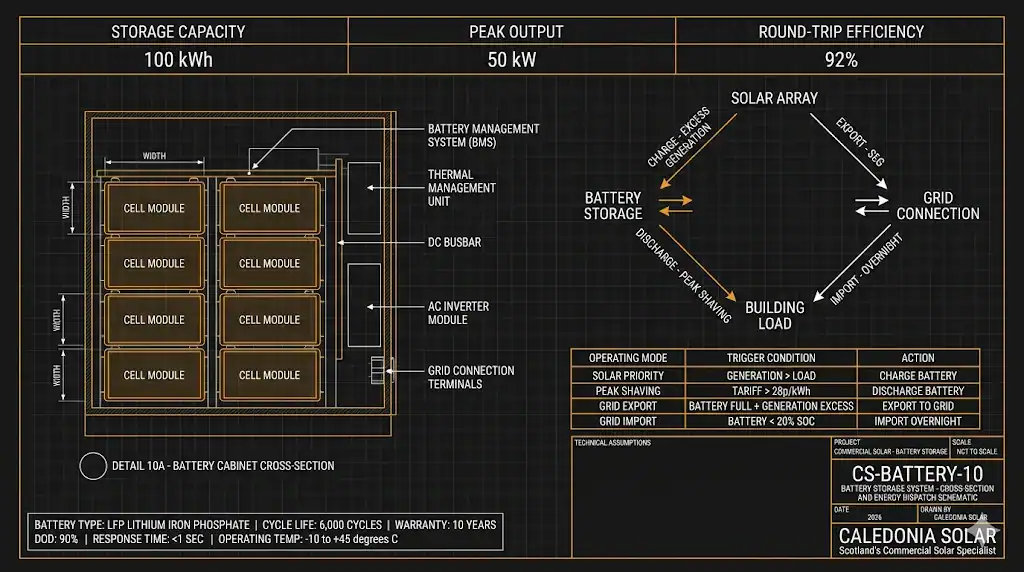
The illustration above brings together the funding structure, grid connection profile, and operational performance characteristics most relevant to cold storage. Each parameter feeds directly into the financial model we build for every project enquiry.
Case Studies
Projects in Cold Storage
Case studies for this sector will be published shortly as projects complete.
Start Your Project →FAQ
Common questions about solar for cold storage
Find out what solar is worth for your cold storage business
Cold storage energy profiles are more complex than standard commercial buildings. Our initial calculator gives an indicative figure - for a full cold store solar model including battery storage options, speak to our team directly.