
Commercial Solar for Scottish Farms and Agricultural Businesses
Scottish farms and rural businesses can combine solar generation with available grant funding to permanently reduce energy costs - with specialists who understand rural grid connections and Scottish agricultural funding.
Sector Overview
Commercial solar PV for the Agriculture sector
Sector overview
Scottish farms and agricultural businesses face a distinctive energy challenge. Grain drying, refrigeration, milking equipment, irrigation, workshop operations and agricultural buildings all generate significant electricity consumption – often on rural sites where grid connections are more expensive and less reliable than urban locations. Solar generation provides a source of local, low-cost electricity that is particularly valuable in rural Scotland, where grid dependency carries additional cost and resilience risk not faced by urban commercial operators.
Caledonia Solar has specific knowledge of the agricultural solar landscape in Scotland, including the Scottish and Southern Electricity Networks (SSEN) DNO processes relevant to rural and Highlands connections, the Scottish Rural Development Programme and other grant schemes available to agricultural businesses, and the planning considerations for solar on agricultural land and buildings. We design projects that fit the physical and financial reality of Scottish farming operations.
Scottish farms and agricultural businesses are among the strongest candidates for commercial solar in the UK - combining large suitable building rooftops, high operational energy intensity and access to Scottish rural grant funding that is not available to urban commercial businesses, resulting in materially better net financial returns than equivalent non-agricultural installations.
The Energy Challenge
The energy challenges facing agriculture businesses
Agricultural businesses on rural grid connections face higher connection costs for any grid upgrades or new connections, and may experience more frequent supply interruptions than urban commercial premises. Solar generation with battery storage provides a local source of electricity that reduces both grid dependency and exposure to supply interruptions - protecting operations that cannot tolerate power outages, such as milking or refrigeration.
Agricultural energy profiles are highly seasonal - grain drying in late summer and autumn, increased heating in winter, peak irrigation in summer. Solar generation also varies seasonally, with peak summer generation broadly aligned with peak agricultural demand for many Scottish farming operations. A system designed around the farm’s specific seasonal profile can deliver high self-consumption rates across the year.
Scottish farms face ongoing pressure on commodity prices, input costs and subsidy income. Energy is a controllable cost that can be addressed through capital investment with a predictable return. Solar generation diversifies the farm’s income through electricity savings and potential Smart Export Guarantee (SEG) income from exported generation, supporting the business case for capital investment on farm.
Why Solar Works in This Sector
Why commercial solar PV works for agriculture businesses
- Rural grant funding availability: Scottish agricultural businesses can access grant support through rural funding programmes that are not available to urban commercial businesses, reducing the net cost of installation.
- SSEN rural grid connection expertise: Caledonia Solar has direct experience of the SSEN DNO process for rural and Highlands grid connections, where the technical requirements and timescales differ from urban SP Energy Networks areas.
- Agricultural building suitability: Farm buildings – sheds, grain stores, dairy units and polytunnel support structures – typically have large, south-facing roof areas well-suited to solar installation without the planning complexity of a greenfield ground-mounted system.
- Self-consumption aligned to farm operations: Daytime agricultural operations including milking, processing, workshop use and irrigation align well with solar generation, enabling high self-consumption rates for farms with active daytime energy demand.
- Ground-mounted options on agricultural land: Where building rooftops are insufficient, ground-mounted systems on lower-value agricultural land can support larger installations. Caledonia Solar advises on planning requirements and the distinction between agricultural permitted development and planning applications for ground-mounted systems.
Indicative Project Parameters
What size commercial solar system does an agriculture building typically need?
Agricultural solar PV in Scotland, combined with available rural grant funding, typically delivers post-grant payback periods of 4–6 years - the shortest of any commercial sector in the UK solar market and significantly better than equivalent unsubsidised urban installations.
Scottish farms that combine solar installation with battery storage can achieve a meaningful degree of grid independence for critical operations - protecting milking, refrigeration and grain drying from supply interruptions that rural grid connections are statistically more likely to experience than urban commercial sites.
How commercial solar reshapes your energy P&L
A well sized commercial solar installation typically displaces 60 to 80 percent of daytime grid consumption, with the strongest yield months running from April through September. Over a 25 year system life, businesses on standard commercial tariffs see total energy spend reduce by hundreds of thousands of pounds depending on system scale and consumption profile.
Grant funding, CapEx with grant contribution, and the rural funding assessment
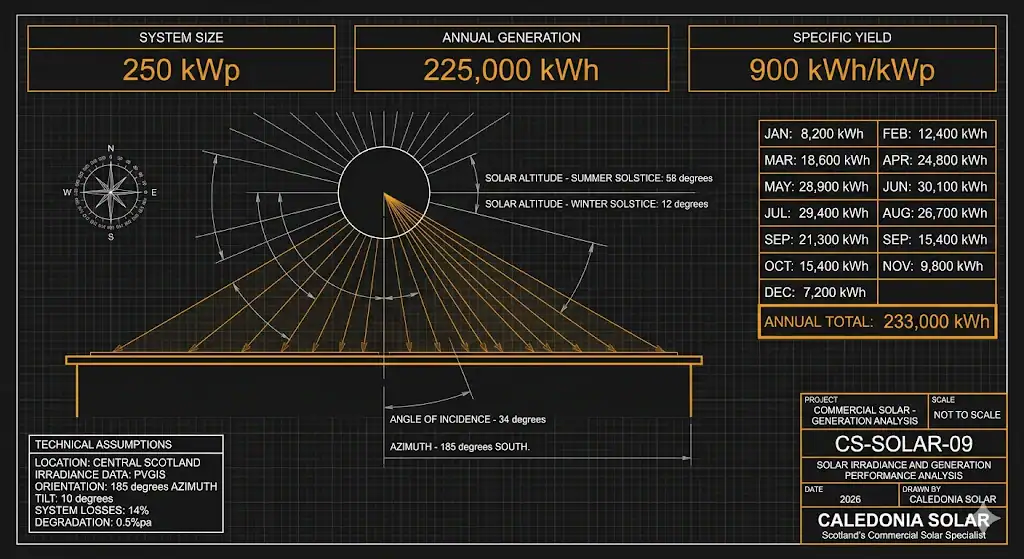
The illustration above brings together the funding structure, grid connection profile, and operational performance characteristics most relevant to agriculture. Each parameter feeds directly into the financial model we build for every project enquiry.
Case Studies
Projects in Agriculture
Case studies for this sector will be published shortly as projects complete.
Start Your Project →FAQ
Common questions about solar for agriculture
Find out what solar is worth for your agricultural business
Agricultural energy profiles vary significantly. Our initial calculator gives an indicative figure - for a full agricultural solar assessment including grant funding options and SSEN connection modelling, speak to our team directly.