
Commercial Solar for Scottish Property Owners and Portfolio Managers
Solar PV improves EPC ratings, protects against MEES compliance risk, reduces service charge energy costs and adds measurable long-term value to commercial property assets across Scotland.
Sector Overview
Commercial solar PV for the Property Portfolio sector
Sector overview
Commercial property owners and portfolio managers in Scotland face an increasingly complex energy and sustainability landscape. Minimum Energy Efficiency Standards, EPC obligations, lender ESG requirements and tenant sustainability commitments are converging to make the energy performance of commercial buildings a material factor in asset value, lettability and long-term yield across Scotland and the wider UK commercial property market. Commercial solar PV addresses several of these pressures simultaneously.
Caledonia Solar works with individual commercial property owners, multi-site portfolio managers and property investment funds across Scotland. We understand the specific considerations of property investment – lease structures, landlord and tenant obligations, planning requirements for listed buildings, and the importance of funding structures that do not encumber the asset. We design, fund and deliver solar projects that improve the commercial performance of property assets without creating structural complications.
Commercial solar is among the most cost-effective capital improvements available to Scottish property owners - typically improving EPC ratings by 1–2 bands, reducing service charge energy costs and delivering documented sustainability credentials, all within a single investment that generates a measurable financial return over the asset holding period.
The Energy Challenge
The energy challenges facing property portfolio businesses
Commercial properties in Scotland must meet Minimum Energy Efficiency Standards to be legally let. Properties with poor EPC ratings face restrictions on letting and the risk of stranded asset status if standards tighten further. Solar PV is one of the most cost-effective interventions available to improve a commercial EPC rating, directly addressing the carbon intensity of electricity consumed in the building.
For multi-let commercial properties, electricity for common areas and shared services is typically recovered through service charge. Rising grid electricity prices increase service charge costs, reducing tenant satisfaction and creating pressure at lease renewal. Solar generation for common area consumption directly reduces service charge energy costs, improving the tenant relationship and protecting income.
Commercial property lenders and institutional investors are increasingly incorporating ESG performance metrics into lending decisions, loan covenants and investment mandates. Properties with demonstrably poor energy performance face higher refinancing risk and reduced access to ESG-linked capital. Solar investment is a tangible, measurable improvement that can be documented and reported against lender or investor sustainability requirements.
Why Solar Works in This Sector
Why commercial solar PV works for property portfolio businesses
- EPC improvement: Solar generation reduces the regulated energy consumption figure in EPC calculations, directly improving the rating and supporting MEES compliance.
- Service charge reduction: Solar generation for common areas reduces the electricity cost recovered through service charge, improving tenant relations and reducing void risk at renewal.
- Asset value protection: Energy-efficient commercial property commands higher rents, lower void periods and better refinancing terms. Solar is a measurable, documented capital improvement.
- Green lease capability: Solar enables green lease clauses that share the financial benefit of generation between landlord and tenant, supporting sustainable tenancy structures.
- Portfolio scale efficiency: Multi-site property portfolios can be structured under a single solar programme with aggregated procurement and funding, delivering significantly better economics than site-by-site approaches.
Indicative Project Parameters
What size commercial solar system does a property portfolio building typically need?
Properties with solar installations are increasingly commanding rental premiums and better refinancing terms in the Scottish and UK commercial property market, as lender ESG requirements and tenant sustainability commitments converge around energy performance.
MEES minimum energy efficiency requirements for commercial lettings continue to tighten in England and Wales, with Scotland expected to follow. Properties that address EPC ratings now - including through solar installation - avoid the cost and disruption of compliance-driven retrofits later.
How commercial solar reshapes your energy P&L
A well sized commercial solar installation typically displaces 60 to 80 percent of daytime grid consumption, with the strongest yield months running from April through September. Over a 25 year system life, businesses on standard commercial tariffs see total energy spend reduce by hundreds of thousands of pounds depending on system scale and consumption profile.
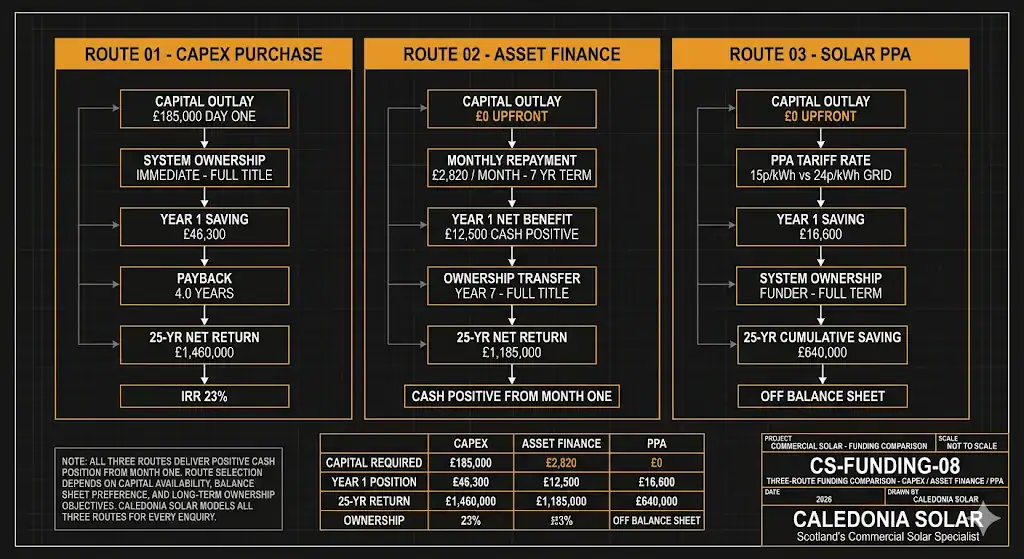
Landlord funding structures, roof licence PPA, and the asset value case
The illustration above brings together the funding structure, grid connection profile, and operational performance characteristics most relevant to property portfolio. Each parameter feeds directly into the financial model we build for every project enquiry.
Case Studies
Projects in Property Portfolio
Case studies for this sector will be published shortly as projects complete.
Start Your Project →FAQ
Common questions about solar for property portfolio
Find out what solar is worth for your commercial property business
For a single commercial property, our calculator gives an indicative EPC impact, annual saving and payback period. For portfolio enquiries, please speak to our team directly.