
Commercial Solar for Industrial and Warehouse Buildings Across Scotland
Large flat roofs, high daytime energy demand and some of the strongest return on investment in the commercial sector - industrial and logistics properties are built for solar.
Sector Overview
Commercial solar PV for the Industrial & Warehousing sector
Sector overview
Industrial buildings, distribution centres and logistics sheds represent the strongest commercial case for rooftop solar in Scotland and the wider UK. The combination of large, unobstructed flat roofs, high and consistent daytime energy consumption, and long building occupancy creates the conditions for maximum solar return – whether funded through CapEx, asset finance or a fully funded Power Purchase Agreement.
Caledonia Solar has specific experience in industrial and warehousing environments, including the design considerations for large flat roofs, trapezoidal metal cladding systems, the structural loading requirements for ballasted and mechanically fixed mounting systems, and the G99 grid connection process for high-capacity installations. For industrial buildings being designed or built now, integrating solar at design stage rather than retrofitting later delivers significantly better outcomes – in system performance, aesthetics and cost.
Industrial and warehouse buildings are the strongest-performing asset class for commercial solar in Scotland - combining the largest available roof areas, the highest self-consumption rates and the longest building tenure of any commercial sector, resulting in the most compelling financial returns.
The Energy Challenge
The energy challenges facing industrial & warehousing businesses
Industrial operations run machinery, lighting, HVAC, compressed air and materials handling systems throughout the working day. For manufacturers and logistics operators, energy is a direct input cost embedded in every unit produced or processed. Rising grid electricity prices translate directly into margin compression - and unlike labour or materials, energy costs have limited scope for negotiation.
Unlike office buildings where occupancy and energy use can be managed flexibly, industrial operations run to production or logistics schedules. Energy demand is high and relatively predictable - which is precisely what makes solar so effective. A system sized to match your operational profile generates free electricity during the hours you need it most.
Industrial businesses are increasingly required to report on scope 2 carbon emissions by customers, supply chain partners and lenders. Solar generation directly reduces the carbon intensity of purchased electricity, improves sustainability credentials and supports compliance with corporate ESG commitments without operational disruption.
Why Solar Works in This Sector
Why commercial solar PV works for industrial & warehousing businesses
- Roof area: Industrial sheds and warehouses typically offer 1,000m²–20,000m² of usable south-facing roof space – the single most important factor in system size and financial return.
- Load profile alignment: Industrial energy demand is concentrated in daytime working hours – the same hours solar generates most effectively. Self-consumption rates of 70–90% are achievable for businesses running single-shift operations.
- Grid connection capacity: Industrial sites typically have larger grid connections than commercial offices or retail units, simplifying the G99 process and enabling larger system capacity without reinforcement works.
- Long tenure: Industrial owner-occupiers and long-term leaseholders can model returns over 20–25 years – the full operational life of a well-specified system.
- Design-in advantage: Buildings currently under design or construction can integrate solar at structural stage, eliminating the cost and complexity of retrofit and maximising system capacity from day one.
Indicative Project Parameters
What size commercial solar system does an industrial & warehousing building typically need?
Industrial solar PV installations above 250kW represent the strongest financial case in the UK commercial solar market, combining the lowest cost per kWp at scale with the highest daytime energy demand profiles of any commercial building type.
How commercial solar reshapes your energy P&L
A well sized commercial solar installation typically displaces 60 to 80 percent of daytime grid consumption, with the strongest yield months running from April through September. Over a 25 year system life, businesses on standard commercial tariffs see total energy spend reduce by hundreds of thousands of pounds depending on system scale and consumption profile.
CapEx, Full Expensing, and the industrial and warehousing funding case
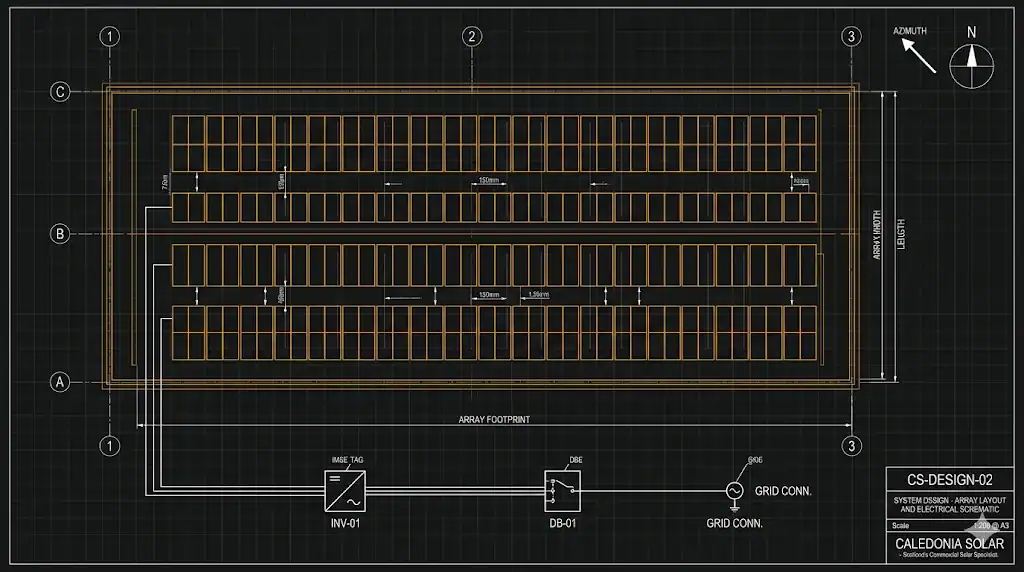
The illustration above brings together the funding structure, grid connection profile, and operational performance characteristics most relevant to industrial & warehousing. Each parameter feeds directly into the financial model we build for every project enquiry.
Case Studies
Projects in Industrial & Warehousing
Case studies for this sector will be published shortly as projects complete.
Start Your Project →FAQ
Common questions about solar for industrial & warehousing
Find out what solar is worth for your industrial and warehousing business
Enter your roof dimensions, monthly energy bill and preferred funding route. Our calculator returns an indicative annual saving, payback period and 25-year return for your specific building - in under 60 seconds.